
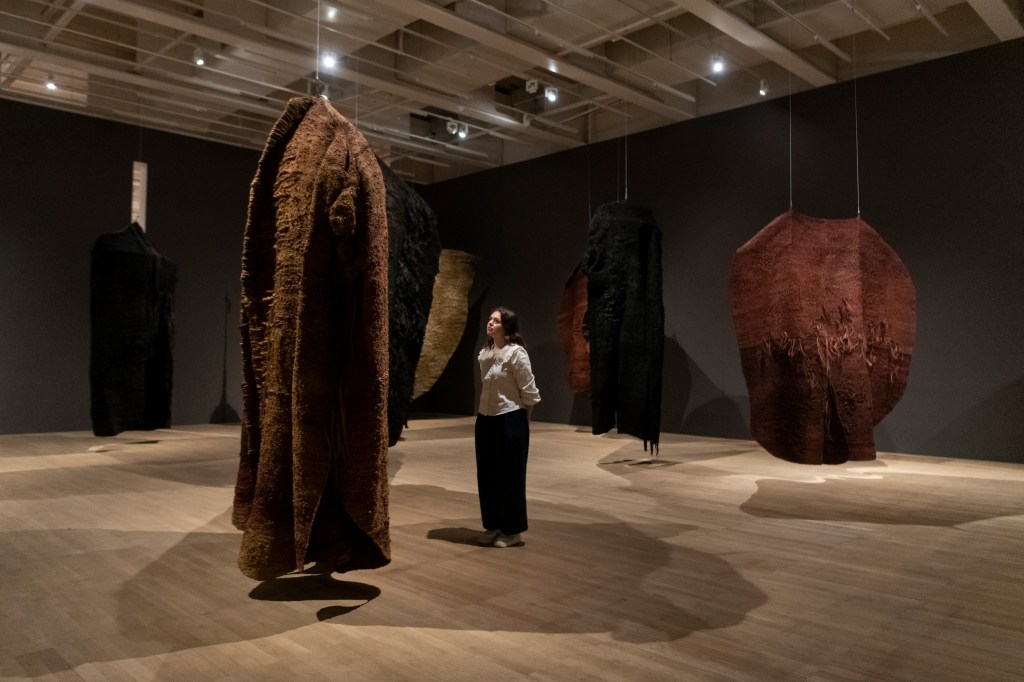
With some of them rearing up in front of the viewer like phantoms, Magdalena Abakanowicz’ extraordinary woven artworks are as mysterious as they are captivating. The artist called them ‘Abakans’ and each are made from richly diverse textile materials drawn (mostly) from natural sources. Many start out as flat and are stitched, so as to fold around and enclose an internal cavity; whilst others are flat, with appendages attached to their surfaces. One important point to establish early on is that they are not three dimensional tapestries, but rather sculptures made of fabric and thread. All are powerful objects with a strong physical and psychological presence.
‘Larger than me, they were safe like the hollow trunk of the old willow I could enter as a child in search of hidden secrets.’
Magdalena Abakanowicz
‘We Are Fibrous Structures’
It was through the art of weaving- the boundaries of which she helped extend in her practice- that the Polish artist Magdalena Abakanowicz formulated her own creative philosophy: ‘I see fibre as the basic element constructing the organic world on our planet… It is from fibre that all living organisms are built, the tissue of plants, leaves and ourselves… our nerves, our genetic code, the canals of our veins, our muscles… We are fibrous structures.’
She may well have been right- and not just in a biological sense- if one thinks of fibre as a line. The almost infinite ways it can link two points in space, cumulatively binding our universe together. So for a few moments, lets consider a few ‘off the cuff’ examples. At the time of writing, scientists have discovered vast cosmic ‘threads’, pointing into the supermassive block hole at the centre of the Milky Way. Or take the vastly intricate, but ultra efficient filaments that make up a fungal mycelia. Even the means of both consciousness and memory function, not to mention the Quantum world and modern telecommunications. Lastly, if you translate ‘factory’ into Polish or Russian, it is ‘fabryka‘. From the Latin ‘fabricationem‘, which means a structure or construction.
The artist also said: ‘I am interested in the path of a single thread’. Could she have been thinking about it in the sense of ‘the root between ‘a’ and ‘b’? Or, was she seeing it in a similar way to Paul Klee, who famously wrote about ‘taking a line for a walk’. In other words, about the potential of that thread? Perhaps she even had both ideas in her mind simultaneously.
When looking at Abakanowicz’ sculptures, you can often see echoes of the natural world, as she drew inspiration from its myriad forms. Yet the finished works are never simply imitative. Perhaps because here was a person who felt in tune with biologocal cycles and processes, as opposed simply to their outward manifestations.
She often used the term ‘Organic’ in relation to her conception of nature, seeking an intimate connection between this and her creative activities. Yet any attempt at defining the term is never going to be straightforward, because it means different things depending on who you talk to. When Abakanowicz used it, she was likely referring on the one hand to the systems of nature already described, but she also shared a concern with human impact on the environment- something that was increasingly apparent in 1970s Poland, due to pollution caused by industrial exploitation. This was the time of ‘acid’ rain and its effects on the forests she knew and cherished was devastating. Forests that were the inspiration not just for the artists’ textile work, but later used as raw material for sculptures themselves.
Although we may recognise the shapes of things in Abakanowicz’ sculptures, they are able to elicit a wider and deeper range of responses in the viewer; using an often abstract visual language that even though it might owe something to previous expressions of Modern art, is the result of a very personal enquiry and experience. These responses are at an emotional, intuitive level- speaking of trauma, childhood and many other things besides.
As I walked through ‘Every Tangle Of Thread And Rope’ at Tate Modern, I instinctively felt the way fabrics have the potential to awaken in us, by their texture or even scent, deep associations that can dredge up fragments of our pasts.

Abakanowicz’ Work In Context
“My only defence against fate is art.”
Larry Poons
One sees in the eloquence of Abakanowicz’ sculptures a measure of the sophistication of the Polish avant-garde; which flourished despite the impositions, restrictions and requirements of the country’s then government. This was something achieved when dialogue between artists and intellectuals on either side of the Iron Curtain was extremely difficult. But not impossible, thanks to those with vision and tenacity like the artist and cultural ambassador Richard Demarco. He recalls:
“I was introduced to the art of Magdalena Abakanowicz as a ‘tapestry artist’ when I first met her in 1969 in her Warsaw studio and I had been quite overwhelmed by the nature of her art, not as essentially tapestry art but as sculpture using fibre materials. I can never forget my first conversation with her when I said that she was not to be considered as a tapestry artist but as a sculptor.” ¹
Half a century later and her art still speaks to us, long after the totalitarian regimes of Soviet occupation in Eastern Europe evaporated into history. Certainly, in their originality and variety, which is amply demonstrated here at Tate Modern; Abakanowicz’ works in both three and two dimensions are a testament to the determination and power of one artistic imagination.
Many of Abakanowicz’ sculptures are suspended from the ceiling by wires and tower over the viewer, appearing to float in mid air. The most dramatic examples confront as sharply defined shapes, yet drape like a coat on a hanger, in which every natural fold is incorporated into their design. By hanging them, the artist makes use of gravity in the way that the heavy fabrics stiffen under their own weight. Some seem a little less defined shape wise, perhaps even deliberately awkward. Yet they are just as powerful, with an almost primitive vitality. A few of the sculptures do not hang, but instead spread out and sprawl, across the floor of the Blavatnik Building. Each is realised in bright or earth colours, whose surfaces have a varied and knotted texture that can be described as felt or rug like; some resembling thick animal wool. Others are made from materials like sisal or horsehair.
‘I like the surface I make of threads, every square inch differs from the others, as in the creations of nature.‘
Magdalena Abakanowicz
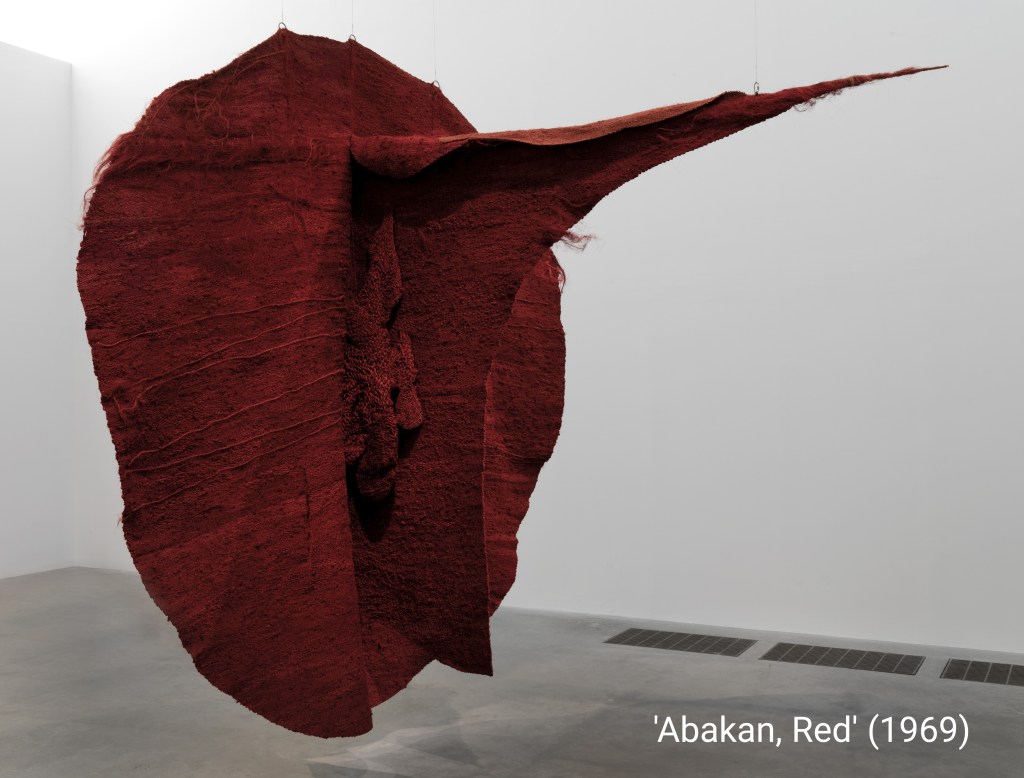
But what do their shapes allude to? In documentary footage accompanying the current show, Abakanowicz appeared happy to let her audience decide for themselves and even tell her what the works actually ‘mean’. However, when you consider Abakanowicz’ formative experiences of war and dislocation, other possible readings present themselves. Considering that she witnessed at a young age her mother being wounded by marauding soldiers, the biological and anatomical aspects of certain sculptures take on a deeper significance. Richard Demarco again:
“I realise that she regarded the language of the visual arts as a healing balm, helping to deal with the agonising pain she and her family suffered when the Russian army arrived in her world with an unbearable degree of violence.” ²
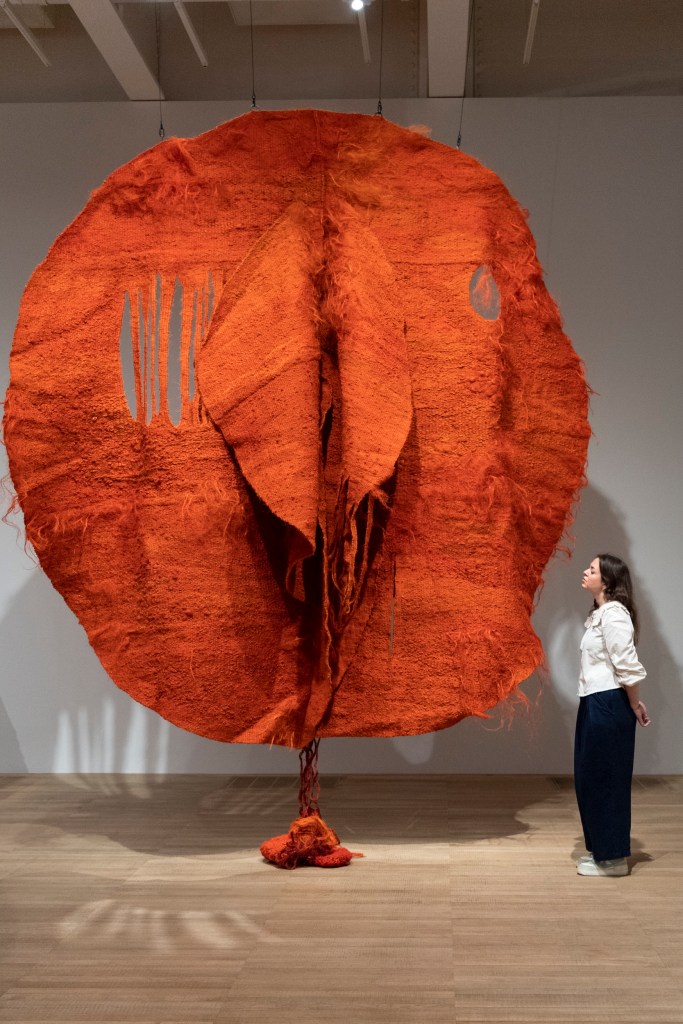
Following on from that idea is a focus on some kind of primordial nurturing, with Uterine and feminine characteristics being quite discernible in several of the sculptures on display; possibly in order to represent the fecundity of natural forces. Additionally, a number of the sculptures have ropes or extensions attached, hanging off them like tendrils. Running out over the floor, they are suggestive- among other things- of bodily networks.
‘The rope to me is like a petrified organism, like a muscle devoid of activity.’
Magdalena Abakanowicz
In ‘Abakan, Situation Variable’ from 1971, the ropes hanging beneath it give the impression of weighing the main body of the sculpture down like chains or cables. At around the same time, Abakanowicz was using rope in a different, more interventionist way, at the 1972 Edinburgh Festival (something examined later).
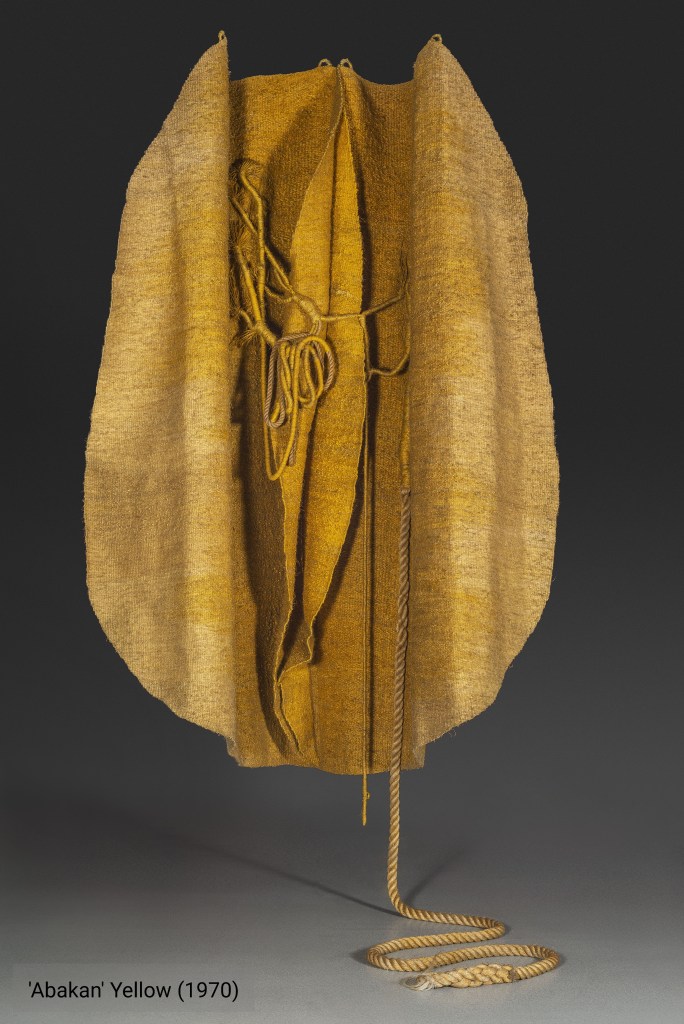
One other observation regarding many of the Abakans, is that although they may be sophisticated works of art, the forms themselves were often achieved with a surprising degree of economy. If for example, we look at ‘Abakan, Yellow’ from 1970, which is essentially made from a few careful folds and extensions.
“If you can do something that might just as well be nothing, but isn’t, it is a much more powerful thing.”
Peter Schmidt
The ‘Abakans’ may form the heart of ‘Every Tangle And Thread’, but we also see evidence of her practice beyond these sculptures. From 1978, she worked on a different series under the title ‘Embryology’. The examples on display here at the Tate are a small and squat collection of stuffed, but soft, taut forms that are arranged in clusters like stones on a beach. They could be a group of cells, even bodies without features or limbs. If so, the bodies are scarred and torn.
Consequently, this installation addresses themes from the artists’ troubled earlier life, to which the viewer will hopefully relate. In her poetic tone of phrase, Abakanowicz said: ‘The contents, the inside, the interior of soft matter fascinated me… What is organic? What makes it alive?’ The kind of questions that reveal the root of her curiosity and empathy. About the borders between that which is alive and dead; animated and sentient, as opposed to inert. Concepts apparent when looking at the marvel which is the cell. After all, where exactly does life start- at what level of matter? Or in an aesthetic sense. What factors make a work of art ‘live’? How, if at all, do these areas converge?
‘They were completing my physical need to create bellies, organs, an invented anatomy. Finally, a soft landscape of countless pieces related to each other.’
Magdalena Abakanowicz

Certain Abakans can be said to exhibit anthropomorphic qualities or are evocative of some kind of primordial shelter. Or the forest of course- a primary inspiration for the artist that never left her. Indeed, the way many of the sculptures are arranged and lit here at Tate Modern evoke that primordial and healing environment.
Finally, without labouring the point about their similarities to cloaks or cowls, I wish to go back to my opening point about certain Abakans appearing like apparitions. I felt these possessed characteristics evocative of powerful authority figures. Yet in their ambiguity, they could just as easily suggest ghosts from a lost past. Anyway, enough of the subjective.

Abakanowicz At Tate Modern
Early on in ‘Every Tangle Of Thread And Rope’, we see how Abakanowicz started as an artist. Emerging from the turmoil of World War Two and subsequent Stalinisation of her homeland, she initially created flat tapestries and applied her design skills to things like book jackets. During the 1960s, Abakanowicz became prominent in the ‘New Tapestry’ movement, despite her first exhibition being closed and her work declared ‘Formalist’ by the upholders of Communist orthodoxy. It was from such beginnings that Abakanowicz began to flourish as an artist, forged by turbulent history.
“With my exhibitions around the world, I wanted to make people aware that my captive country still had a high level of old culture…. and is at the same time able to speak about the recent reality with the very personal strong voice of modern art.”
Magdalena Abakanowicz
By grouping works into categories like ‘Situations’ or ‘Environments’, Abakanowicz hoped to give an extra dimension to them. Each work interacting with those around it, in dialogue and in sympathy with their setting. This is something impossible to replicate for the obvious reason that each location is unique. Nevertheless, the arrangements here at Tate Modern have adequate lighting (the ‘right’ kind of lighting for the sculptures) and plenty of space, adding an almost theatrical element to their display. This is something that doesn’t keep the spectacular at a distance either- quite the opposite in fact. On another tangent, I presume that each work requires a very specific set of instructions to ensure that it is hung correctly; because surely the margin for error when preparing them for exhibition must be very small indeed.
The artists’ more expanded activities are documented and contextualised towards the final section of the show. This also offers the viewer an overview of her career; both at home and abroad. Lastly, Abakanowicz was, from a young age, a keen collector of interesting fragments from nature. In support of her work. we see natural forms like shells and animal horns at various places throughout the exhibition.
The Ties That Bind Us
With regard to works that are site specific, a particular location could become the central element, even the genesis of a work. Richard Demarco recalls the way Abakanowicz “played an important role as a sculptor during the Edinburgh Festival of 1972. Her sculpture consisted, essentially, of an enormous length of rope, painted a deep red. She regarded it as an umbilical cord linking the Richard Demarco Gallery with the three spires of Saint Mary’s Episcopal Cathedral at distance of a quarter of a mile from one window in the main gallery space of what was essentially an 18th century Town House. This enormous rope was inserted through an aperture in the window and re-emerged attached to one of the Cathedral spires. To this day, I believe that this was one of the nodal points in the seventy-five-year history of the Edinburgh Festival. The cultural world of the Edinburgh Festival was seen to be physically linked to that of a House of Prayer.” ³
Aside from the obvious themes of history and unity inherent in ‘Red Rope’ from 1972, this emphasis on place and setting is also to be seen in the wonderfully evocative 1969 film ‘Abakany’, which is a collaborative production between Abakanowicz and director Jarosław Brzozwski. We see sculptures situated in the desert like terrain of Słowiński National Park on the Baltic, as well as the artist in her studio, putting them together and giving advice to an assistant. Situating examples in such a desert like scape- a neutral and timeless backdrop- emphasises the Abakans’ poetic and formal qualities. As a consequence, the viewer is asked to read each sculpture against the eternity of natural forces. The film highlights the mysterious qualities of the work, helped in no small part by Bogusław Schäffer’s evocative music.
What also comes over in the film is just how careful the artist was in arranging the way her sculptures should be seen; something that went beyond simply good presentation. Which poses an additional question as to how necessary, or even relevant, is the standard ‘White Cube’ (neutral) backdrop to fully appreciating the Abakans. Something I find not so easy to answer.
In Conclusion
One can certainly say that ‘Every Tangle Of Thread And Rope’ is an apt title for this show, as there is surely a significance to every stich and knot.
Moving through the last section of the exhibition, which mostly consists not of art works themselves, but documentation, I found to be extremely useful. Although it was cramped in contrast to the rest of the show, it presented Abakanowicz’ many other works and ideas, beyond the Abakans.
A single sculpture on display before the exit consisted of part of a large withered and blackened tree, whose ends were topped with metal bands. This was a fragment from ‘War Games’ (1987-1995) taken from a forest in the Masurian Lakes region of present day Poland; a huge area of forest and water where, over a century before at the start of the First World War, epic (and decisive) battles between German and Russian forces had occurred. The land had then been on the borders of these huge empires, at a time before the re-establishment of the nation of Poland. Here is a work that is yet another example of the significance of location in relation to history; something which, as we have seen, was so important to Abakanowicz.
Truncated, the tree had the appearance of a broken body and was one of a series in which each was specifically, almost cryptically named. The rest of the sculptures I’ve seen pictured elsewhere looked quite different from one another. But all possessed poise and balance, laying on their side.
The tree at Tate Modern sat looking, to my eyes at any rate, like a bomb relic of the kind so proudly displayed by the Russians, if one compares it to say the famous ‘Tsar Bomba’. The largest Hydrogen Bomb ever exploded.
Finally, as I am writing this at the very moment ‘Every Tangle Of Thread And Rope’ is closing, it would be extremely misinformative of me to recommend a visit to something that has already finished. However, I have no hesitation in recommending Magdalena Abakanowicz’ art to anybody and to say this exhibition has been a revealing and satisfying experience.
(C) Gideon Hall 2023
All quotations by Magdalena Abakanowicz, except where stated and 1, 2 and 3, which were kindly provided by Richard Demarco (a big thank you to him and Terry-Ann Newman for their support).
 Gideon Hall